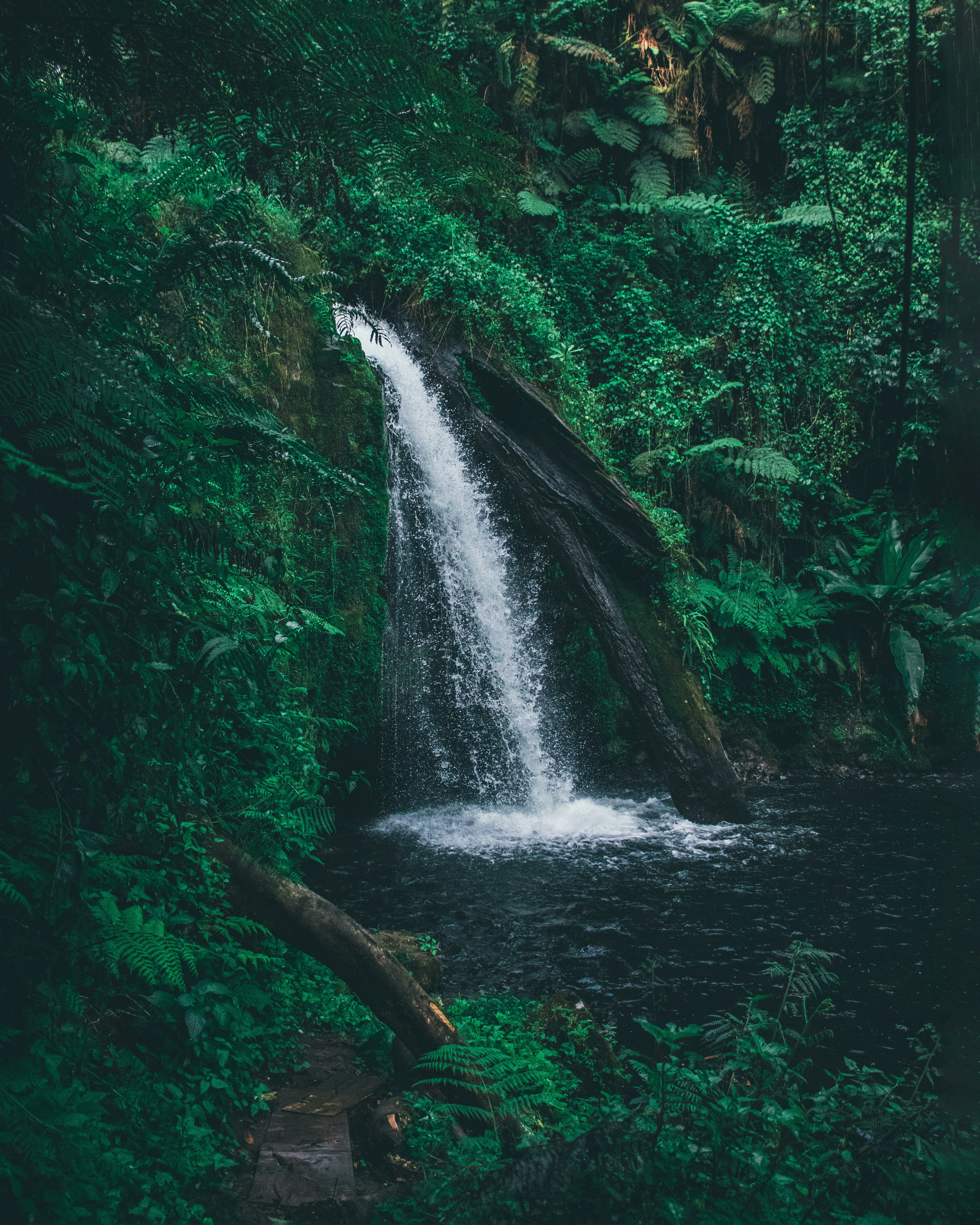
Aberdare National Park is unlike any other park in Kenya. Where the Masai Mara offers open savanna and the Rift Valley lakes offer flamingos, the Aberdares deliver highland montane forest, moorland mist, dramatic waterfalls, and a wildlife list dominated by rare forest species. At 767 km², the park spans the Aberdare Range from dense bamboo forest to open moorland above 4,000m.
The Aberdares have a particular place in Kenya’s history: Treetops Lodge, built inside the park over a waterhole, is where Queen Elizabeth II received news of her father’s death in February 1952 — and where, accordingly, she became Queen of the United Kingdom. The original lodge was destroyed by fire in 1954 and rebuilt. The current version was destroyed again in 2024.
Wildlife
The Aberdares’ forest ecosystem supports species you will not find on the open savanna.
Bongo antelope: The mountain bongo is one of Africa’s rarest forest antelopes. Aberdare National Park is one of Kenya’s primary strongholds for this species. Bongo sightings are not guaranteed — they are shy and use dense forest — but early morning game drives along forest tracks, particularly in the Salient (the lower western extension of the park), produce sightings a significant proportion of the time. Kenya Wildlife Service rangers can advise on current movement patterns.
Black and white colobus monkey: Common throughout the forest, particularly in areas of large fig trees. Troops can often be heard before they are seen. These are large, dramatic monkeys with flowing white capes — one of the most photogenic primates in Africa.
Lion and leopard: Both species are present in the Salient and moorland sections. Leopards are more commonly seen; the forest provides excellent cover and the Salient’s waterhole areas (The Ark, Treetops area) are productive spots, particularly at night.
Black rhino: A small population of black rhino inhabits Aberdare. Numbers are low and sightings rare, but the rhino is present. The park forms part of a broader highland rhino conservation zone.
Elephant and buffalo: Both species move freely through the park and into adjacent forest. Elephant herds in Aberdare are forest-adapted — smaller family groups than in Tsavo or Amboseli, often seen on moorland grassland or forest clearings at dawn.
Giant forest hog: These large, heavily built relatives of the warthog are common at Aberdare. They are frequently seen at the Ark waterhole and forest clearings at night. At up to 275kg, they are the world’s largest wild pig species.
Serval and African wild cat: Both small wild cats are present and occasionally spotted on night game drives from the tree lodges.
Tree Lodges: The Ark
The Ark Lodge is Aberdare’s signature experience. Built on stilts over a floodlit waterhole and salt lick inside the park, it operates on a fixed-arrival system: guests arrive in the afternoon, spend the night watching wildlife from multiple viewing decks, and depart the following morning.
Wildlife comes to the waterhole throughout the night. Buffalo, elephant, giant forest hog, bushbuck, waterbuck, and occasional leopard and hyena are regularly recorded. A buzzer system in each room alerts guests if a rare or unusual animal appears.
The Ark is a full-board property that includes park entry fees in its rates. Approximate rate (as of 2026): USD 280–350 per person per night all-inclusive. The lodge is run in conjunction with Mountain Lodge at the forest edge — guests typically transfer from Mountain Lodge by Land Cruiser convoy through the forest.
Note on Treetops Lodge: Treetops was destroyed by fire in June 2024. As of 2026, reconstruction is reportedly underway but the property is not operational — verify current status before planning around it.
Waterfalls
The Aberdares receive heavy rainfall from both the Indian Ocean and Atlantic weather systems — annual rainfall in parts of the park exceeds 3,000mm. This produces some of Kenya’s most dramatic waterfalls.
Karuru Falls: The highest single-drop waterfall in Kenya at approximately 273m. Located in the central Aberdares above the Salient. The falls are accessible on foot from the park road; the hike takes around 1–2 hours return depending on starting point.
Chania Falls: Accessible from Nyeri side, near Nyeri town. A scenic double waterfall with pools at the base. Popular for day visits from Nyeri.
Gura Falls: Remote and rarely visited — reaching them requires a full day hike. The falls drop over 300m in a series of cascades through dense forest. Arrange a KWS ranger guide in advance.
Entry Fees and Park Gates
Fees (approximate, as of 2026):
- Non-resident adult: approximately USD 52 per person per day
- Non-resident child (3–17): approximately USD 35 per day
- Kenyan citizen adult: approximately KES 1,050 per day
- Vehicle entry: approximately KES 200–400
Note: Tree lodge guests (The Ark) typically have park entry included in their accommodation rate — confirm at booking to avoid double payment.
Main gates:
- Kiandongoro Gate (eastern, near Nyeri): primary entry for Salient and tree lodge access
- Mutubio Gate (western, near Naivasha): higher moorland access
- Ruhuruini Gate (northern, near Naro Moru)
Opening hours: 06:00 to 18:00 daily. The Ark operates overnight stays — guests stay inside the park after gate closing.
Getting There
From Nairobi (approximately 130km to Nyeri):
- Self-drive via A2 north to Nyeri takes around 2.5 hours. Turn east from Nyeri town toward Kiandongoro Gate, adding 30 minutes.
- Shuttle buses (Easy Coach, Modern Coast) run Nairobi-Nyeri from approximately KES 500–700 per seat; journey time 3 hours. Arrange a local taxi or lodge transfer from Nyeri to the park gate.
From Nanyuki (approximately 60km):
- Self-drive south via B5 to Nyeri, then east to Kiandongoro Gate. Around 1.5 hours.
From Nakuru (approximately 80km):
- Via C72 or A104, entering from the western Mutubio Gate side. Around 2 hours.
Where to Stay
Inside the park (tree lodges):
- The Ark: approximately USD 280–350 per person per night, all-inclusive including park entry, game drives, and full board. Book directly through Aberdare Country Club.
- Aberdare Country Club (forest edge, Mweiga): a more conventional lodge at the park boundary where Ark guests stage overnight. Rates approximately USD 180–250 per person full board.
Outside the park (Nyeri area):
- Aberdare Country Club: colonial-era club at the park boundary; rooms from approximately USD 150–200 per person full board.
- Outspan Hotel, Nyeri: historic hotel linked to Baden-Powell (founder of Scouting). Rates from approximately USD 80–130 per person per night bed and breakfast.
- Green Hills Hotel, Nyeri: good mid-range town hotel for self-drive visitors; rooms from approximately USD 60–90 per night.
Best Time to Visit
January to March (short dry season): The moorland and forest are dry enough for comfortable hiking and game drives. Wildlife is active. Kilimanjaro views are good from the higher moorland. Temperatures at altitude drop to 8–15°C at night.
July to October (peak dry season): Dry, clear, and cool at altitude. Night temperatures can drop below 10°C — pack layers. Animal activity at the Ark waterhole is reliably high during dry periods. This is the busiest period.
April to June and November (rain seasons): The Aberdares are dramatically beautiful in the wet season — waterfalls are at maximum volume and forest birds are active. Roads inside the park can become difficult or impassable after heavy rain. Recommended only for visitors with high-clearance 4WD and experience with forest tracks.
Birdwatching
The Aberdares support a specialised highland bird community distinct from Kenya’s savanna parks. Key species include:
- Jackson’s francolin (endemic to Kenya’s central highlands)
- Aberdare cisticola (range-restricted to the Aberdare moorland)
- Montane nightjar
- African emerald cuckoo
- Bar-tailed trogon
- Hunter’s cisticola
- Scarlet-tufted sunbird (on giant lobelia at moorland elevations)
The Salient section is most productive for forest species. Moorland above 3,000m adds alpine specialists. A serious birder can expect 80–120 species over two days.
Combining with Other Parks
The Aberdares sit between Nairobi and Mount Kenya. A natural circuit runs Nairobi, Aberdare (1–2 nights), Nanyuki and Ol Pejeta Conservancy (1–2 nights), then south back to Nairobi. For a longer Kenya highlands loop, add Lake Nakuru (2 hours west of the Aberdares via Nakuru town) — read our Lake Nakuru National Park guide.
If you prefer a guided visit, browse Aberdare National Park tours on GetYourGuide — options include full-day game drives with park fees, tree lodge packages, and guided night drives that give the best chance of forest wildlife sightings.
For the ecology of Aberdare’s highland forest — the science behind melanistic leopards, forest elephant behaviour, colobus monkey territories, and the moorland bird species list — see our Aberdare wildlife guide.