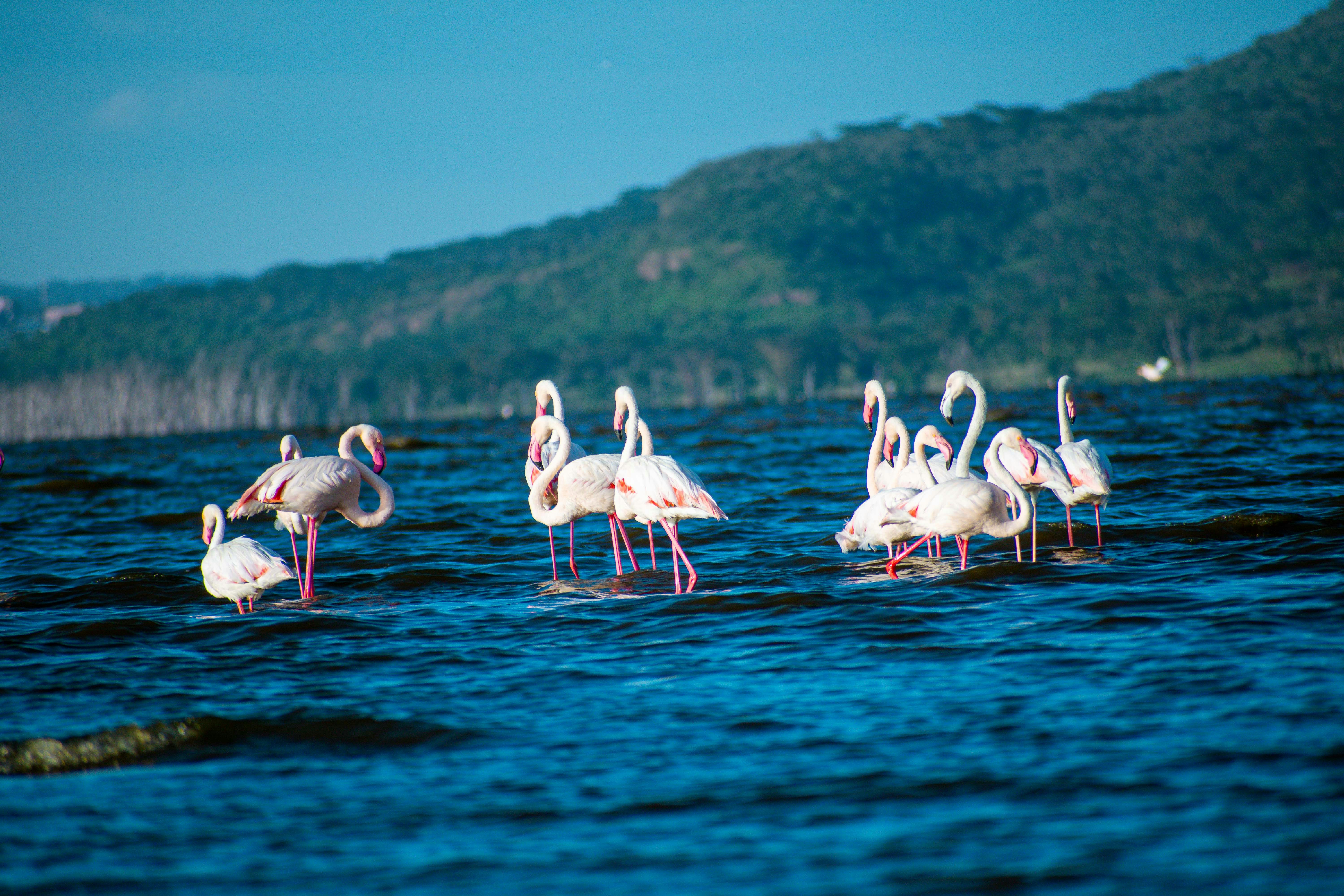
Lake Nakuru National Park covers 188 km² of Rift Valley floor around Kenya’s most famous soda lake. The lake’s alkaline waters support vast blooms of blue-green algae — the food source that draws flamingos in numbers that at their peak turned the shoreline pink. Nakuru is also Kenya’s most significant rhino sanctuary, protecting both white and black rhinos behind an electric fence. Combined with lions, leopards, and over 450 bird species, it makes one of the most concentrated wildlife destinations in East Africa.
The park sits at 1,750–2,073m above sea level, giving it a distinctly cooler character than coastal or low-altitude parks. Temperatures range from 12°C at night to 25°C midday — a welcome break from the heat of Tsavo or the coast.
Flamingos: What to Expect
Lake Nakuru’s flamingo spectacle is one of the most famous wildlife images in Africa. At peak concentrations, the lake supported over 1 million flamingos — a pink ring visible from the escarpment viewpoints above.
Flamingo numbers are inherently variable. Lake Nakuru is a soda lake — its alkalinity depends on water levels, which shift with rainfall patterns. When water rises (as it has done significantly since 2012), algae concentrations thin and birds disperse to other Rift Valley soda lakes, primarily Lake Bogoria (about 80km north) and Lake Elementaita (30km southeast, a UNESCO World Heritage site).
Current situation (2026): Lake Nakuru remains an excellent flamingo destination, but guarantee-level concentrations are no longer consistent. Visitor reports typically describe flocks of tens of thousands to several hundred thousand birds. The most spectacular displays occur when water levels stabilise at a moderate depth. If flamingos are your primary objective, check recent posts on birding forums or contact Kenya Wildlife Service before your visit.
Both species are present: Greater flamingo (larger, predominantly white with pink highlights) and lesser flamingo (smaller, deeper pink, most numerous). Lesser flamingos feed on algae in the shallows; greater flamingos filter bottom sediment.
Wildlife
White rhino: Lake Nakuru’s fenced sanctuary has successfully established a significant white rhino population. White rhinos are grazers, found on the open grassland and short-grass areas between the lake and the treeline. They are large, docile, and among the easiest of Africa’s Big Five to photograph — vehicles can approach to within 30–50 metres on open ground.
Black rhino: Also present, though in lower numbers and harder to find. Black rhinos are browsers (they eat leaves and shrubs) and use the thicker forest on the park’s slopes. Dawn and dusk are the best times. Nakuru is one of Kenya’s better parks for black rhino sightings relative to national average.
Lions: A resident pride uses the lake shore, grassland areas, and the acacia woodland in the south. The Makalia Falls area and the southern treeline are productive lion areas. Sightings are regular but not guaranteed.
Leopards: Present in the forested escarpment sections. Baboon Hill is a traditional leopard location — the name gives a clue as to what the leopards are hunting.
Buffalos: Large herds graze the grassland, particularly in the western section of the park near Lanet.
Waterbuck, impala, eland, Bohor reedbuck, olive baboon: All common throughout the park.
Rothschild’s giraffe: Lake Nakuru is a stronghold for this endangered giraffe subspecies (distinguished from the more common Maasai giraffe by its lack of markings below the knee). A dedicated Rothschild’s giraffe population has been established inside the sanctuary.
Birdwatching
450+ species recorded, placing Lake Nakuru among Kenya’s top birdwatching parks. Key species:
- Greater and lesser flamingo (in variable concentrations)
- African fish eagle (reliable, calls constantly)
- Great white pelican (regular, breeding colony present)
- Goliath heron, grey heron, purple heron (lake shore)
- African jacana (lily-pads at Lanet)
- Verreaux’s eagle (on the escarpment cliffs)
- African crowned eagle (in forested escarpment)
- Over 50 raptor species recorded
The Rift Valley viewpoint on the eastern escarpment offers panoramic views over the lake and is an excellent raptor-watching site in the morning thermals.
Entry Fees and Park Gates
Fees (approximate, as of 2026):
- Non-resident adult: approximately USD 60 per person per day
- Non-resident child (3–17): approximately USD 35 per day
- Kenyan citizen adult: approximately KES 1,050 per day
- Vehicle entry: approximately KES 200–400 depending on vehicle type
Fees are paid via eCitizen. The park is only 3km from Nakuru town — making it one of Kenya’s most accessible major parks. A day visit from Nakuru is straightforward.
Main gate: Main Gate (Lanet Road, 3km from Nakuru town centre). Also Nderit Gate (southern, less frequently used).
Opening hours: 06:00 to 18:00 daily.
Getting There
From Nairobi (approximately 160km):
- Self-drive via A104 west through Naivasha — around 2.5 hours. Nakuru town is well-signed.
- Matatus and shuttle buses (Easy Coach) run Nairobi to Nakuru from approximately KES 400–700 per seat; journey 2.5–3 hours. Nakuru town is 3km from the park gate (boda-boda motorbike or taxi KES 100–200).
- Nairobi to Nakuru by SGR (Standard Gauge Railway) takes around 3 hours from Syokimau station; trains run twice daily. Fare approximately KES 700–1,200. Nakuru railway station is in the town centre — then arrange onward transfer.
From Lake Naivasha (approximately 60km):
- 1 hour self-drive northwest on A104. A common pairing for a 2-day Rift Valley circuit.
Where to Stay
Inside the park:
- Lake Nakuru Lodge: full-service lodge inside the park with good lake views and a pool; approximately USD 130–180 per person on full board.
- Sarova Lion Hill Lodge: well-positioned on the escarpment with panoramic lake and flamingo views; approximately USD 150–220 per person on full board.
- Mbweha Camp: boutique tented camp on the park’s western boundary with good privacy; approximately USD 120–170 per person on full board.
KWS campsites:
- Backpackers’ campsite and public campsites available at approximately USD 30–40 per person. Self-catering only. Book via eCitizen.
In Nakuru town (budget/mid-range base):
- Merica Hotel: reliable mid-range town hotel; rooms from approximately USD 60–90 per night.
- Midland Hotel: town centre location, good value; rooms from approximately USD 40–70 per night.
Best Time to Visit
July to October (peak dry season): Clearest skies, dry tracks, and concentrated wildlife at the lake edge. Game viewing across all species is at its most reliable. Flamingo numbers can be good if water levels are stable.
January to March: Dry and warm. Good rhino and lion viewing. Slightly lower accommodation rates than peak season.
November to December (short rains): The rains bring lush vegetation and returning migratory birds. The park is beautiful and uncrowded. Flamingo concentrations sometimes build as algae recolonises post-rain. Tracks remain passable in most conditions.
April to June (long rains): Heaviest rainfall period. The park is green but some tracks become muddy. Wildlife disperses from the lake shore. This is the least-recommended period unless birdwatching is the primary goal and budget is a priority.
Pairing Lake Nakuru with Other Rift Valley Destinations
Lake Nakuru sits at the centre of Kenya’s Rift Valley lake circuit. Common pairings:
- Lake Naivasha (60km south via A104): freshwater lake with hippos, Crescent Island walking safari, Hell’s Gate National Park adjacent. 1 hour drive.
- Lake Bogoria (80km north): Kenya’s premier flamingo site when Nakuru water levels are high. Geysers and hot springs add interest. Half-day or full-day excursion from Nakuru.
- Lake Elementaita (30km southeast): UNESCO World Heritage site, small and scenic, flamingos and pelicans. Easy addition to a Nakuru day.
- Aberdare National Park: 2 hours northeast via Nyeri. Excellent 2-park combination covering both highland forest and Rift Valley soda lake ecosystems.
Browse Lake Nakuru day tours and safari packages on GetYourGuide — options include guided day trips from Nairobi, flamingo and rhino game drives, and combined Nakuru and Naivasha itineraries.
For a deeper look at the ecology behind Lake Nakuru’s flamingo fluctuations, the Rift Valley soda lake chain, and the conservation history of the rhino sanctuary, see our Lake Nakuru flamingos and wildlife guide.