Tipping in Kenya sits somewhere between expectation and appreciation. It is not the rigid obligation you find in the United States, nor is it the rarity it can be in parts of Europe. In practice, tips form a meaningful part of take-home pay for service workers across the tourism industry — from the guide who tracked a leopard for two hours to the porter who carried your bag up six flights of stairs. This guide covers who to tip, how much, and how to navigate the handful of situations where tipping norms are genuinely unclear.
The General Attitude Toward Tipping
Most Kenyans working in tourism understand that visitors from different countries have very different instincts about tipping. There is no hard social rule that applies uniformly across the country. In Nairobi’s upmarket restaurants and in the Maasai Mara’s private camps, tips are quietly expected and built into staff expectations. In local matatu stages, street food markets, and boda-boda stops, tips are a pleasant bonus but not anticipated.
The single most important thing to know: always tip in cash. Mobile money (M-Pesa) is ubiquitous among Kenyans but it is impractical for you as a visitor to use for tipping unless you have a registered Kenyan SIM and account. Cards do not facilitate tips at most properties. Carry small-denomination KES notes specifically for tipping — KES 100, 200, and 500 notes are the most useful.
Safari Guides and Drivers
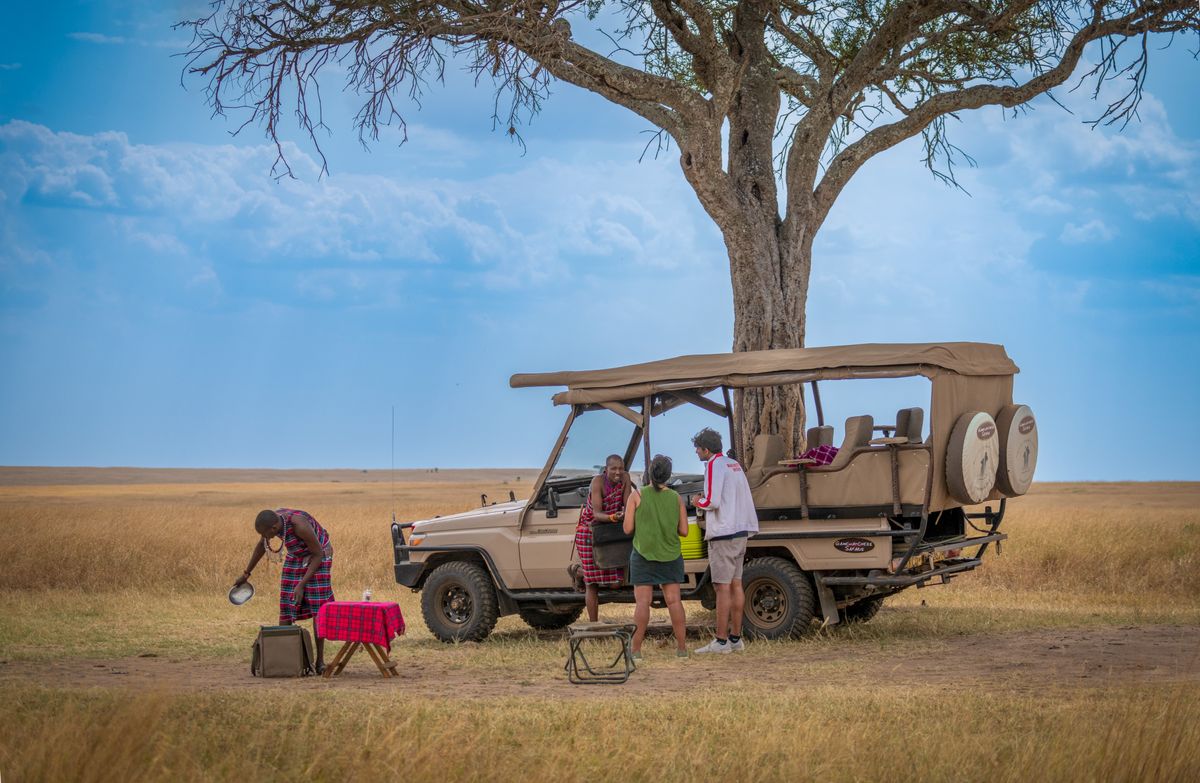
This is where tipping matters most and where amounts are highest. Safari guides and driver-guides in Kenya typically earn a base wage from the operator and rely on tips to bridge the gap to a reasonable income. The standard guidance from most reputable operators:
- Full-day guide / driver-guide: USD 10-20 per guide, per day (approximately KES 1,300-2,600)
- Half-day or short game drive: USD 5-10 per guide (approximately KES 650-1,300)
- Multi-day specialist guide (e.g., birding specialist, night drive guide): USD 20-30 per day (approximately KES 2,600-3,900)
Tip at the end of your stay, not after each game drive — it allows the guide to see the full scope of your trip. Hand the tip directly and personally; do not leave it in the vehicle.
Lodge and Camp Staff
At most lodges and tented camps, collective tipping for the broader staff team is standard practice. Many properties have a dedicated tip box at reception; if not, hand tips to the camp manager and ask them to distribute.
- All-inclusive lodge or camp: USD 5-10 per person, per day for the general staff pool (approximately KES 650-1,300 per person per day)
- Butler or dedicated room attendant: USD 3-5 per day on top of the general pool (approximately KES 390-650)
- Porter at lodge: KES 200-300 per bag (approximately USD 1.50-2.50)
Restaurants
The norm varies by restaurant type. At upmarket restaurants in Nairobi, Karen, Westlands, and the Mombasa seafront, check your bill first — a 10% service charge is often included automatically. If it is, no additional tip is required, though leaving the coins from change is a common courtesy.
At mid-range restaurants and cafes without a service charge:
- Sit-down restaurant, good service: 10% of the bill is standard
- Casual cafe or local restaurant: round up to the nearest KES 100 or leave KES 100-200
- Nyama choma spot or local canteen: not expected, but KES 50-100 is always appreciated
Do not feel pressured to tip if service was genuinely poor. Tipping is voluntary and a reflection of the interaction.
Taxis and Ride-Hailing
For metered taxis and negotiated fares, rounding up is the norm rather than a percentage tip. For app-based services such as Bolt or Uber, the app allows an in-app tip after the ride, though cash is also accepted.
- Taxi with negotiated fare: round up to the nearest KES 50 or KES 100
- Bolt or Uber: KES 100-200 tip for a good journey (approximately USD 0.75-1.50)
- Tuk-tuk in coastal areas: round up to the nearest KES 50
Boda-boda (motorcycle taxi) drivers are usually paid a negotiated fare; tipping is not standard but rounding up is common on a longer or more challenging journey.
Hotels and Guesthouses
- Porter carrying bags to room: KES 200-500 per trip (approximately USD 1.50-4), depending on the number of bags and distance
- Housekeeping: KES 200-300 per night (approximately USD 1.50-2.50); leave on the pillow or on the desk with a note
- Concierge who arranged a complex booking: KES 500-1,000 (approximately USD 4-8), depending on effort
Budget guesthouses and Airbnb stays do not have the same expectation as full-service hotels. A tip here is a genuine gesture, not a social obligation.
Salons and Spa Services
Tipping at salons and spas in Kenya is not a fixed custom, but it is becoming more common in Nairobi and in tourist-facing spa facilities at lodges and hotels.
- Haircut or blowdry at a salon: 10% of the service cost, or round up to the nearest KES 100
- Massage or spa treatment at a lodge: KES 500-1,000 (approximately USD 4-8) is typical, depending on treatment length
- Manicure or pedicure: round up or add KES 100-200
Cash vs Digital Tipping
Almost all tipping in Kenya happens in cash. M-Pesa is the country’s dominant payment system but you would need a registered Kenyan SIM to send money that way. A handful of upmarket restaurants in Nairobi now allow card tips, and Uber and Bolt handle tips inside the app. Outside those specific contexts, assume cash only and plan accordingly.
Common Mistakes Tourists Make
Over-tipping in USD at local restaurants. Handing a USD 5 note to a local canteen waiter when the meal cost KES 300 creates awkwardness and inflates expectations for future visitors. Match the scale of the tip to the venue.
Forgetting small notes. A KES 5,000 note is useless for tipping. Before any tour or lodge stay, break larger notes at a supermarket or ATM and carry a supply of KES 100 and KES 200 notes.
Tipping after each game drive instead of at the end. Most guides prefer a single end-of-safari tip that reflects the full experience. Multiple small tips across the trip feel transactional and are harder to track.
Assuming service charge is a tip. On a Kenyan restaurant bill, the 10% service charge goes to the establishment, not necessarily to the staff who served you. If you want to reward a specific server, a small additional cash tip handed directly to them is more meaningful.
Tipping only the guide and ignoring trackers and assistants. On high-end safaris with a dedicated tracker riding on the vehicle bonnet, they deserve a tip too — typically at least half the guide rate, so USD 5-10 per day (approximately KES 650-1,300).
A Practical Reference
| Situation | Amount (KES) | Amount (USD) |
|---|---|---|
| Safari guide, per day | 1,300-2,600 | 10-20 |
| Lodge staff pool, per person per day | 650-1,300 | 5-10 |
| Hotel porter, per trip | 200-500 | 1.50-4 |
| Housekeeping, per night | 200-300 | 1.50-2.50 |
| Restaurant, no service charge | 10% | 10% |
| Taxi / ride-hail | 100-200 | 0.75-1.50 |
| Salon or spa treatment | 100-1,000 | 1-8 |
Exchange rate used throughout: approximately KES 130 per USD 1 (as of 2026 — rates fluctuate, check before travel).