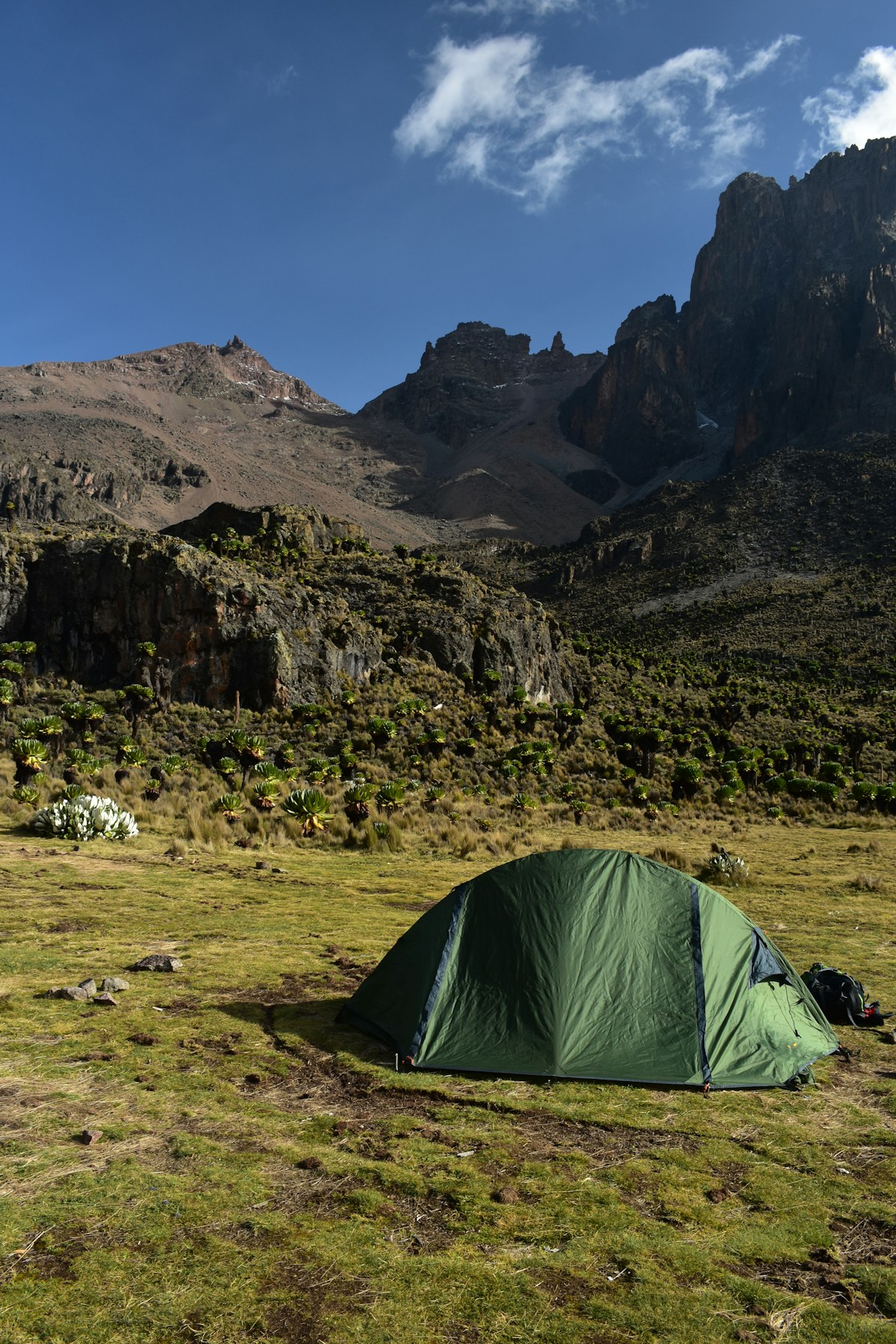
Mount Kenya (5,199m) is Africa’s second-highest mountain and a genuine trekking objective that does not require technical climbing skills to reach the main trekker’s summit, Point Lenana (4,985m). The mountain sits on the equator, two hours north of Nairobi, and offers a sharp contrast to the safari savanna that most visitors associate with Kenya: glaciers, high alpine moorland, giant lobelias, and rocky peaks above 4,000 metres. For the broader Kenya trekking and hiking landscape, see the Hell’s Gate cycling and walking guide and the Mount Longonot hike guide.
This guide is aimed at first-time Mount Kenya trekkers - it covers route selection, what to expect on the mountain, the operators worth considering, what to budget, and how to maximise your chances of a successful summit day.
The Summit Options
Point Lenana (4,985m): The trekking summit. Reached by a non-technical scramble from Austrian Hut (4,790m), typically starting at midnight to arrive at sunrise. Snow and ice possible on the final approach - trekking poles and gaiters useful, crampons occasionally required in wet season.
Batian (5,199m) and Nelion (5,188m): Technical rock climbs requiring prior mountaineering experience, rope skills, and a climbing guide. Not suitable for standard trekkers.
Is Mount Kenya Right for You?
Point Lenana (4,985m) is reached by a non-technical trail and does not require rope skills or prior mountaineering experience. It does require:
- Good physical fitness and the ability to hike 8–12 hours in a day carrying a daypack
- No active cardiovascular conditions - altitude puts significant strain on the heart
- Mental preparedness for cold, dark, and some discomfort on summit night
- Minimum 4 days on the mountain for adequate acclimatisation (some operators offer 3-day trips - these are too fast and carry significant altitude sickness risk)
If you have trekked at moderate altitude before (3,000m+) without problems, Mount Kenya is achievable with preparation. If this is your first experience above 3,000m, allow extra acclimatisation time and listen to your body.
The Main Routes
Sirimon Route (Recommended for First-Timers)
The most gradual ascent route, starting at Sirimon Gate on the northwest side of the mountain. The trailhead is 17km from Nanyuki, accessible by car in 30 minutes.
Why choose Sirimon: The daily altitude gain is lower than Naro Moru, making acclimatisation easier. The moorland and Afro-alpine landscape on the approach is varied and interesting. Old Moses Camp at 3,300m is a comfortable first night with good facilities.
Search hotels in Kenya on Booking.com
Typical 4-day schedule (Sirimon ascent, Naro Moru descent):
- Day 1: Sirimon Gate (2,650m) → Old Moses Camp (3,300m) - approximately 4–5 hours
- Day 2: Old Moses → Shipton’s Camp (4,200m) - approximately 6–7 hours, crossing the Mackinder Valley
- Day 3: Rest and acclimatisation at Shipton’s - short hike to Kami Tarn (4,400m) recommended
- Day 4: Pre-dawn summit push (midnight departure) → Austrian Hut (4,790m) → Point Lenana (4,985m) → descent to Naro Moru Gate
The summit push: The ascent from Austrian Hut to Point Lenana takes approximately 2–3 hours in the dark, on steep scree and sometimes ice. You will arrive at the summit near sunrise - clear days give views across to Kilimanjaro, the Aberdares, and north toward the NFD.
Naro Moru Route (Fastest)
The most direct route, used by operators offering 3-day ascents. The Naro Moru trailhead is off the main Nanyuki highway, 176km from Nairobi.
The Vertical Bog: A steep, severely waterlogged section between the roadhead and Meteorological Station Hut (3,050m). Extremely muddy in the April–May and October–November wet seasons. Gaiters are essential.
Who should use it: Experienced high-altitude trekkers returning for a second climb, or those with very limited time. For a first ascent, the shorter schedule (typically 3 days) allows insufficient acclimatisation - add a rest day at Mackinder’s Camp to improve your odds.
Chogoria Route (Most Scenic)
The Chogoria route approaches from the east, passing the spectacular Gorges Valley and Lake Michaelson before reaching the summit plateau. It is widely considered the most beautiful route on the mountain.
Best use: As the descent half of a Sirimon–Chogoria traverse (ascend west side, cross the summit plateau, descend east). This gives you the best scenery in both directions.
Logistical note: You need transport arranged at both gateways. Operators based in Nanyuki can handle this, but confirm it is included in the package before booking.
Named Operators with Prices
Operators are based in the three main gateway towns. Prices below are approximate as of 2026 - get quotes from at least two operators and check exactly what is included.
Nanyuki-based operators (Sirimon Gate)
Mount Kenya Guides and Porters Association (MKGPA) The official guide association based at Nanyuki. You can hire directly through MKGPA rather than through a commercial operator, which reduces margins. Guide rate: approximately USD 40–60/day. Porter: approximately USD 25–35/day. You arrange your own accommodation (hut bookings via Mountain Club of Kenya) and meals separately.
Base Camp Kenya A well-regarded local operator offering full packages including guide, porter, hut fees, and meals. 4-day Sirimon–Naro Moru: approximately USD 280–350/person. 5-day Sirimon–Chogoria: approximately USD 380–450/person. Prices vary with group size. Guided Mount Kenya trekking tours can also be compared online to find vetted operators with verified reviews.
Summit Trail Adventure Another Nanyuki-based option, similar pricing range. Ask specifically about acclimatisation protocols - operators who pad the schedule with rest days generally deliver better summit success rates.
Naro Moru-based operators
Naro Moru River Lodge The traditional Mount Kenya operator on the west side, running guided treks since the 1960s. Full packages available. 4-day Naro Moru package: approximately USD 300–380/person.
Budget option: hiring directly at the gate
If you have experience organising mountain treks, you can arrive at the Sirimon or Naro Moru gate and hire a licensed guide directly from the guides waiting there. This works but requires:
- Cash in USD or KES for guide and porter fees
- Pre-booked hut fees via Mountain Club of Kenya (mckenya.co.ke) - huts fill up in peak season
- Your own food for the mountain
This approach costs approximately USD 200–250/person for 4 days (guide + porter + hut fees + park entry, self-catered). It gives you less support if something goes wrong.
Permits and Entry Fees
KWS Park Entry: Approximately USD 35/day non-resident adult, as of 2026. Paid online at kws.go.ke before arrival. For a 4-day trek, this is approximately USD 140/person in park entry alone.
Mountain hut fees (per night):
- Old Moses Camp (3,300m): approximately USD 20/person
- Shipton’s Camp (4,200m): approximately USD 25/person
- Austrian Hut / Top Hut (4,790m): approximately USD 20/person
Book huts in advance through the Mountain Club of Kenya (mckenya.co.ke) or through your operator. The July–September period is peak season - huts book out weeks in advance.
Camping fees: Approximately USD 15/person/night at designated campsites.
Best Seasons
January–February: The short dry season. Clear skies, good summit visibility, firm underfoot conditions. The best weather window of the year for high-altitude success rates. For month-by-month conditions across Kenya, see our best time to visit Kenya guide.
August–September: The long dry season. Second-best window. Slightly more precipitation than January–February but still generally dry. Peak season - more trekkers on the mountain and huts book out faster.
June–July: Shoulder season. Drier than average, reasonable conditions. Less crowded than August.
April–May (long rains) and October–November (short rains): The wet seasons. The Vertical Bog on Naro Moru becomes genuinely impassable in heavy rain. Summit visibility is poor. Most experienced operators advise against attempting Point Lenana in these months.
Acclimatisation
Altitude sickness (acute mountain sickness, AMS) is the primary risk on Mount Kenya. The mountain reaches nearly 5,000m - high enough for symptoms in unacclimatised trekkers regardless of fitness level.
The standard rules:
- Above 3,000m, ascend a maximum of 300–500m per day in sleeping altitude
- Build in at least one rest day at Shipton’s Camp (4,200m) before the summit push
- “Climb high, sleep low” - a day hike above camp altitude before sleeping lower helps acclimatisation
- Descend at the first sign of severe AMS symptoms: severe headache, vomiting, loss of coordination, confusion
Diamox (acetazolamide): Available in Kenyan pharmacies (Nanyuki, Nairobi). Widely used as an altitude acclimatisation aid. Consult a doctor before using - it has interactions and contraindications.
Hydration: Drink 3–4 litres of water per day on the mountain. Dehydration worsens altitude sickness symptoms significantly.
What to Budget (All-In)
For a 4-day guided trek using a package operator from Nanyuki:
| Item | Approximate cost (per person) |
|---|---|
| Operator package (guide, porter, hut fees, meals) | USD 280–380 |
| KWS park entry (4 days) | USD 140 |
| Gear hire (sleeping bag, poles if needed) | USD 20–40 |
| Transport Nairobi → Nanyuki (return) | USD 20–30 |
| Pre-trek accommodation in Nanyuki | USD 25–50 |
| Total | approximately USD 485–640 |
The direct-hire route saves approximately USD 80–120 on operator margins but requires more organisation and provides less support.
All prices are approximate and as of 2026. Confirm current KWS entry fees and operator rates before booking.
Getting to Nanyuki
Nanyuki is 200km north of Nairobi on the A2 highway. Journey time by car: approximately 2.5–3 hours. See the Nanyuki city guide for accommodation options and transport details in the gateway town.
By public transport: Modern Coast Express, EasyCoach, and several other companies run Nairobi–Nanyuki services daily (approximately KES 500–700, 3 hours). Nanyuki has a well-developed small-town infrastructure - several guesthouses, ATMs, pharmacies, and gear hire shops near the market area.
Chogoria trailhead: On the east side of the mountain, approximately 30km off the main Meru road. Approximately 220km from Nairobi - less convenient to reach but the scenic approach and Gorges Valley compensate. Guides available at the gate; fewer established operators than the west side, so it’s worth arranging in advance through a Nanyuki-based operator if doing the Sirimon–Chogoria traverse.
Pre-trek overnight in Nanyuki: Strongly recommended. Arriving at the trailhead rested and not after a long early-morning drive gives you a better day one. Budget guesthouses in Nanyuki town from approximately KES 1,500–2,500/night; mid-range from approximately KES 4,000–8,000.
What to Bring
Essential gear for Point Lenana:
- Warm layers: down jacket or equivalent rated to -10°C minimum (summit night conditions with windchill can reach -15°C)
- Waterproof jacket and trousers
- Gloves (two pairs - inner and outer)
- Warm hat and balaclava for summit night
- Waterproof hiking boots, broken-in before the trek
- Trekking poles (essential for descent from the summit, and on the Vertical Bog section)
- Headlamp with spare batteries (pre-dawn summit start)
- Sunscreen SPF50+ and sunglasses (UV at altitude is intense)
- Sleeping bag rated to -5°C minimum (huts are cold)
Gear hire is available in Nanyuki for sleeping bags (approximately KES 500–1,000/night) and trekking poles (approximately KES 300–500/day). Quality varies - bring your own sleeping bag if possible.
For the wildlife of Mount Kenya’s lower slopes and forest zone, see our Mount Kenya wildlife guide. For acclimatisation days and gear supplies before your climb, the Nanyuki city guide covers the nearest gateway town. For what to pack for the mountain, see our Kenya packing list. A mountain rescue carries significant cost - comprehensive travel insurance including mountain rescue is essential.