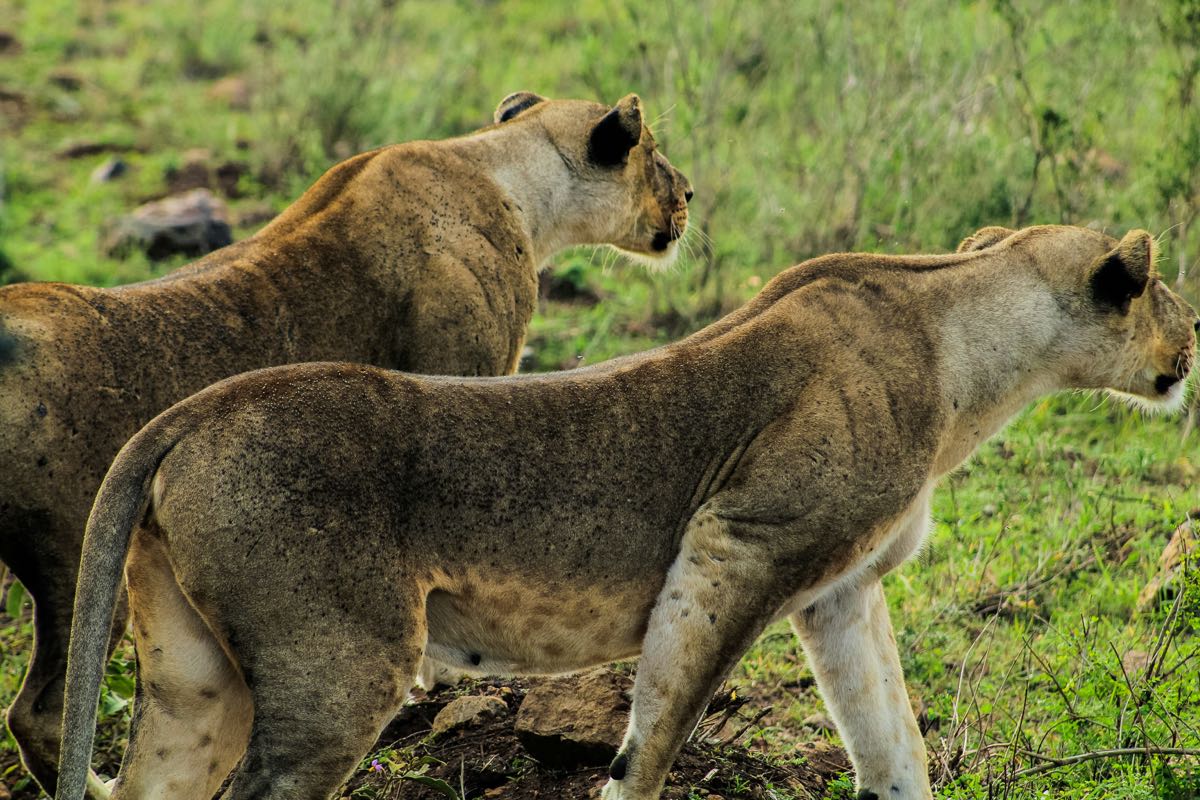
Nairobi National Park is one of the most improbable wildlife destinations on earth - 117 square kilometres of open savanna, riverine forest, and wetlands sharing a boundary fence with one of Africa’s busiest cities. The park’s southern boundary is open to the Kitengela wildlife dispersal area, allowing seasonal wildlife movement. The city skyline visible from the northern reaches of the park has become the park’s defining visual. For a broader Nairobi wildlife day, the Giraffe Centre is 15 minutes away in Karen.
Black Rhinoceros - Nairobi’s Most Significant Wildlife Story
Nairobi National Park is one of Kenya’s most important sanctuaries for the critically endangered black rhinoceros (Diceros bicornis). Kenya’s wider black rhino population was hunted to near-extinction by poachers during the 1970s and 1980s, falling from an estimated 20,000 animals to fewer than 500 by 1984. The Nairobi National Park population has been carefully protected and monitored since then.
The park currently holds approximately 50 black rhinos - one of the highest densities of this species anywhere in Africa. Sightings are not guaranteed on any single game drive, but the Hippo Pools area, the forest edges along the Mbagathi River, and the grassland around Impala Observation Hill have the best rhino records.
Black rhinos are solitary and difficult to approach - they will move away from vehicles and can charge unpredictably if surprised. Keep all vehicle noise to a minimum and maintain a distance of at least 100m.
Lions
Nairobi National Park has a resident lion population of approximately 30–35 individuals in 4–5 prides. Pride territories include the central plains, the area around Hyena Dam, and the southern riverine areas.
Lions are most active in the early morning (6–9am) and late afternoon (4–7pm). Midday hours (10am–2pm) see lions resting in shade, still visible but inactive. The Hyena Dam area and the Central Grassland circuit (accessible from the main gate) are the most reliable areas for lion encounters.
Cheetahs
The park’s cheetah population fluctuates between 5–10 individuals depending on dispersal patterns. Cheetahs are more active than lions during the day and prefer the open grassland in the central and southern sections of the park. They hunt impala (the park’s most common prey species), and a cheetah hunt - if you’re positioned correctly - is the most dramatic wildlife experience available in Nairobi.
The open plains around Nairobi Safari Walk junction and the Main Gate plains are the best starting areas for cheetah searches.
Leopards
Leopards are present in the park’s riverine forest along the Mbagathi River and the forested areas near the southern boundary, but sightings are rare. Leopards are primarily nocturnal and spend most of the day concealed in dense cover. After rains, when game trails become visible in the vegetation, guide-led drives produce better results.
Buffalo
Large buffalo herds - up to 300 animals - use the central and southern grasslands, particularly during the dry season when grass is shorter. Buffalo are reliable near water sources (Hyena Dam, Athi Dam) during the dry months. They are the park’s most dangerous species for on-foot encounters and visitors must stay inside vehicles outside designated viewpoints.
Search hotels in Nairobi on Booking.com
Giraffes and Plains Game
Masai giraffes are common throughout the park, particularly on the acacia grasslands in the north and east. They’re the most frequently photographed animals against the Nairobi skyline.
Common zebra and wildebeest move seasonally between the park and the Kitengela dispersal area. During the dry season (June–October), herds of several thousand zebra and wildebeest congregate inside the park.
Other common species include eland (the world’s largest antelope), impala (the most numerous ungulate in the park), warthog, kongoni (Coke’s hartebeest), and Grant’s gazelle.
Hippopotamus
Hippos are resident along the Mbagathi River and in the Hippo Pools viewpoint area in the northwestern corner of the park. The Hippo Pools - a series of permanent water pools along a section of the Mbagathi - reliably holds 20–40 hippos. There is a designated parking and viewing area. The pools are one of the park’s most accessible wildlife viewpoints.
Birdlife (400+ Species)
Nairobi National Park has one of the highest bird species counts of any national park in the world relative to its size. The diversity reflects the range of habitats - open grassland, acacia scrub, riverine forest, wetland, and rocky hillsides.
Notable species: African fish eagle (calls across Hyena Dam), secretary bird (walks the open grassland hunting snakes), kori bustard (Africa’s heaviest flying bird), and Verreaux’s eagle (hunts rock hyrax along the park’s rocky margins). The wetland areas hold saddle-billed storks, yellow-billed storks, African spoonbills, and grey crowned cranes.
Park Fees and Entry
Non-resident adult: Approximately USD 35/person/day + USD 45/vehicle as of 2026. Resident adult: Approximately KES 215/person/day. Children (non-resident): Approximately USD 25/person/day.
Entry via the ecitizen portal (parks.go.ke). Prepayment is required. The main gate is Langata Road Gate, 7km from the CBD on Langata Road.
Visiting Options
Self-drive: The park’s gravel roads are manageable in a standard saloon car during the dry season. A map is available at the main gate (also downloadable from the KWS website). Self-drive is legal and many Nairobi residents drive their own vehicles.
Guided drive: Several Nairobi operators offer morning guided game drives from approximately KES 4,000–6,000/person including the park fee. Let’s Go Travel and African Quest Safaris are established operators. You can also book a Nairobi National Park tour that includes transport, a guide, and entry fees in a single package. Guides significantly increase wildlife detection rates. For a full day’s wildlife itinerary, combine the park with a visit to the David Sheldrick Wildlife Trust elephant orphanage, 10 minutes from the park entrance.
Opening hours: 6am–7pm daily. The 6am slot is strongly recommended.
For more Nairobi day activity options, see our Nairobi things to do guide. For longer safaris, see our Masai Mara safari guide. For a complete Nairobi park activity guide, see our Nairobi National Park activity guide, and pair a morning game drive with a visit to the David Sheldrick Wildlife Trust for a full wildlife day.