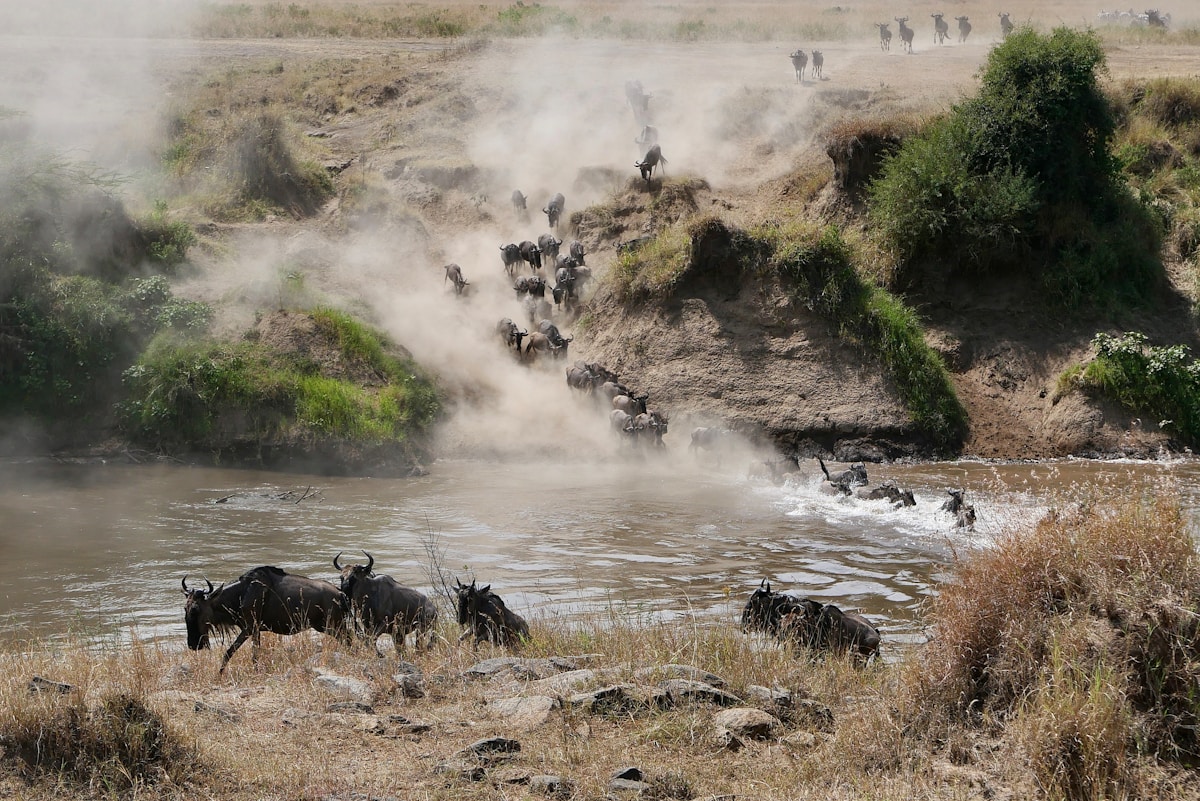
The Masai Mara and the Serengeti are effectively two halves of the same ecosystem, divided only by the Kenya-Tanzania border. Both host the same Great Migration, the same Big Five, and some of the highest predator densities on earth. But they feel different, cost differently, and suit different types of traveller.
Here’s how they compare.
What’s Actually the Same
The wildebeest don’t recognise the border. Approximately 1.5 million wildebeest, plus zebra and gazelle, move continuously between the Serengeti’s vast plains and the Masai Mara’s open grasslands following the rains. Both parks are part of the same savanna ecosystem - wildlife spills freely across the invisible line.
Both offer genuine Big Five sightings. Both have a wide range of accommodation from mobile tented camps to permanent lodges. Both require a 4WD vehicle and a guide.
Where They Differ
| Factor | Masai Mara (Kenya) | Serengeti (Tanzania) |
|---|---|---|
| Total area | ~1,510 km² national reserve + conservancies | ~14,763 km² national park |
| Entry fee | Approximately USD 80/person/day (non-residents) as of 2026 | Approximately USD 82/person/day (non-residents) as of 2026 |
| Access from capital | 5–6 hrs by road or 45–60 min by light aircraft from Nairobi | 8–12 hrs by road or 60–90 min by chartered flight from Kilimanjaro or Arusha |
| Best time for river crossings | Late July–October | Some crossings at Mara River (north Serengeti), Aug–Oct |
| Best time for calving | Not applicable | January–March (southern Serengeti / Ndutu area) |
| Vehicle density | Can be high at key crossing points | High at river crossings; quieter in southern/western sectors |
| Off-road driving | Permitted in conservancies; restricted in national reserve | Mostly on-track within the national park |
| Crowd management | Private conservancies offer exclusivity | Varies significantly by zone |
| Entry currency | USD or KES accepted at gates | USD required |
Masai Mara: Strengths
Accessibility. Wilson Airport (Nairobi) has scheduled charter services to Mara airstrips - the most common are Ol Kiombo, Mara North, and Keekorok. Operators including Safarilink and Air Kenya run multiple daily departures. Road is also a real option from Nairobi (5–6 hours via B3 highway).
Private conservancies. The Mara ecosystem includes large private conservancies - Olare Motorogi, Naboisho, Mara North - that border the national reserve. These allow off-road driving, walking safaris, and night drives that are banned inside the main reserve. They have stricter vehicle limits and often feel more exclusive.
River crossings. The Mara River runs through the reserve and conservancies. Between late July and October, wildebeest crossings are a daily spectacle - with crocodile attacks making it dramatic. No other safari destination delivers this at the same intensity.
Serengeti: Strengths
Scale. The Serengeti has room to get lost. The Ndutu plains in the south, the central Seronera valley, the remote Loliondo and Lamai sectors in the north - the landscape changes dramatically as you travel. You can be in the Serengeti for 10 days and never repeat a view.
Year-round migration. Because the Serengeti is so large, the migration herds are almost always within the ecosystem. Calving season (January–March, Ndutu area) is a spectacular, underrated alternative to the river crossings - predator action is intense and the scenery is different.
Ngorongoro combination. Most Tanzania itineraries combine the Serengeti with Ngorongoro Crater - a collapsed caldera with extraordinary Big Five density. This combination, often including Olduvai Gorge for archaeology, creates a Tanzania safari experience with genuine variety that the Mara alone cannot match.
Fewer vehicles in peripheral zones. While the Seronera area and northern river crossings can be busy, the western corridor and southern plains are vastly less visited.
Costs
Masai Mara (Kenya)
- National reserve entry: approximately USD 80/person/day (non-residents) as of 2026
- Private conservancy fees: typically USD 100–150/person/night on top of accommodation
- Budget camps: from approximately KES 30,000/person/night (USD 230) full board
- Mid-range tented camps: approximately KES 55,000–120,000/person/night (USD 420–920) all-inclusive
- Luxury lodges (Angama Mara, Mahali Mzuri): from approximately USD 1,100–2,500/person/night as of 2026
Serengeti (Tanzania)
- National park entry: approximately USD 82/person/day as of 2026
- Budget camps outside the park: from approximately USD 150/person/night
- Mid-range tented camps: from approximately USD 400–700/person/night all-inclusive
- Luxury (Four Seasons, &Beyond, Singita Faru Faru): from approximately USD 1,500–4,000/person/night as of 2026
Tanzania’s conservation levy structure means the park entry fee tends to be built into lodge rates, making direct price comparison tricky - always check whether fees are included before booking.
Where to Stay
Masai Mara
- Governors’ Camp (Mara North Conservancy): one of the oldest camps on the Mara; from approximately USD 600/person/night all-inclusive as of 2026.
- Entim Mara Camp (southern reserve): solid mid-range option; from approximately USD 450/person/night.
- Bateleur Camp (&Beyond): luxury; from approximately USD 900/person/night.
- Mara Serena Safari Lodge: large and popular, good for families; from approximately USD 350/person/night.
Search hotels in Kenya on Booking.com
Serengeti
- Asilia’s Ubuntu Migration Camp: follows the migration; from approximately USD 700/person/night.
- Serengeti Serena Safari Lodge (Seronera): reliable mid-range base; from approximately USD 400/person/night.
- Singita Faru Faru Lodge: flagship luxury property; from approximately USD 1,500/person/night.
- Ndutu Safari Lodge (southern Serengeti, calving season): from approximately USD 350/person/night.
Which Should You Choose?
Choose the Masai Mara if: (browse Masai Mara tours)
- You’re based in Kenya and want to minimise travel time
- The river crossing spectacle is your main goal (July–October)
- You want off-road flexibility via a private conservancy
- You’re on a first safari and want concentrated, efficient wildlife viewing
- Budget is a consideration - Kenya generally has more mid-range camp options
Choose the Serengeti if:
- You want maximum scale and variety in landscape
- Calving season (January–March) interests you
- You’re combining with Ngorongoro Crater
- You can spend 7+ days in Tanzania
- You want fewer vehicles in peripheral areas
Choose both if you can. A 10–12 day itinerary combining 3–4 nights in each, crossing via Isibania, gives you the full ecosystem picture without repetition. For more on Kenya’s park options, see our Kenya safari guide.
For Kenya-specific planning, see our Masai Mara safari guide, Great Migration Kenya guide, and Masai Mara where to stay guide. The Nairobi to Masai Mara itinerary covers getting to the Mara from Nairobi by road or air.
Plan Your Trip
✈️ Book your flights to Kenya 🛡️ Get travel insurance 📱 Stay connected with an eSIM 🚗 Rent a car